What types of fake news circulated in the initial Covid-19 outbreak?
And are debunkable facts or non-debunkable allegations the main social media threat in a context characterized by high uncertainty?
This post inaugurates a series by Pomlab and its partners.
We analyzed 7M tweets in Italian authored from Feb to May 2020 and tracked 10 fake news ideas like Covid is a #Gates or Soros conspiracy, #5g causes Covid, Vitamin C ensures protection, #migrants are immune to Covid. Tweets explicitly mentioning these are 1.44% of the total.
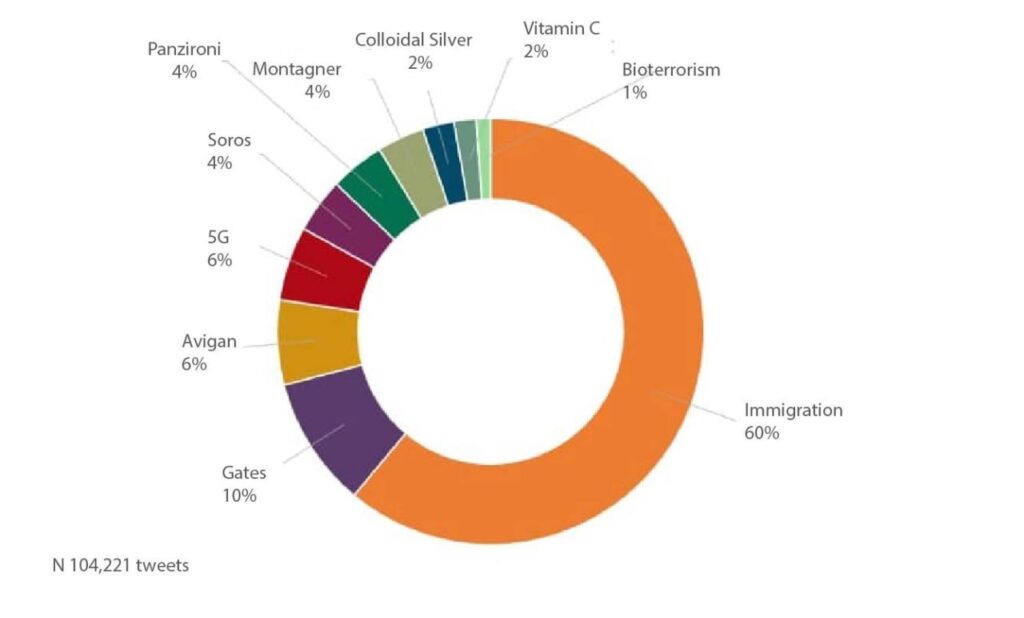
Fake news involving #migrants were the most active portion. However #migrant fake news do not present debunkable facts but biased representations of migrants in association with the Covid context.
Videos of African migrants violating quarantine or news extracts showing crimes committed by migrants or reporting fear (eg an old lady who fears migrants will squat her home if she stays in hospital).
This is also somewhat typical of #gates posts, which do not usually contain fake facts, but rather un-debunkable allegations about how Bill Gates is going to profit from the pandemic, eg through vaccine monopoly.
Tweets containing fake facts (eg. #5g causes covid; #colloidalsilver or #avigan cure it) usually rank much lower in distribution. This is probably due to active debunking and stigma as users have learned to recognize these .
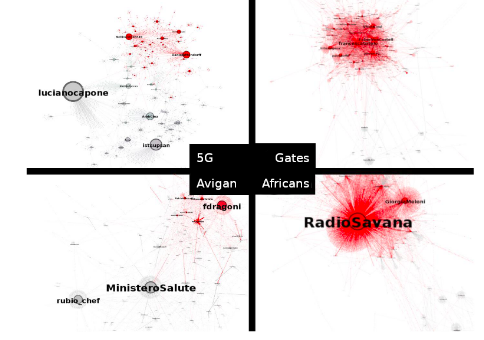
The RT networks help to understand the differences. On the left, debunkable fake news; on the right, non-debunkable news. Red nodes are actively distributing fake news. Nodes in grey are actively debunking fake news.
Non-debunkable fake news generate networks that are structured as echo chambers i.e. no debate happens (the “message” is not the actual fact but the comments and their tone).
The entire article by @novemillimetri @caliviral and Valentina Sturiale was published on Mediascapes https://ojs.uniroma1.it/index.php/mediascapes/article/view/17105/16362